The Candy Bombers: a Meditation on Kindness, Courage and Christmas
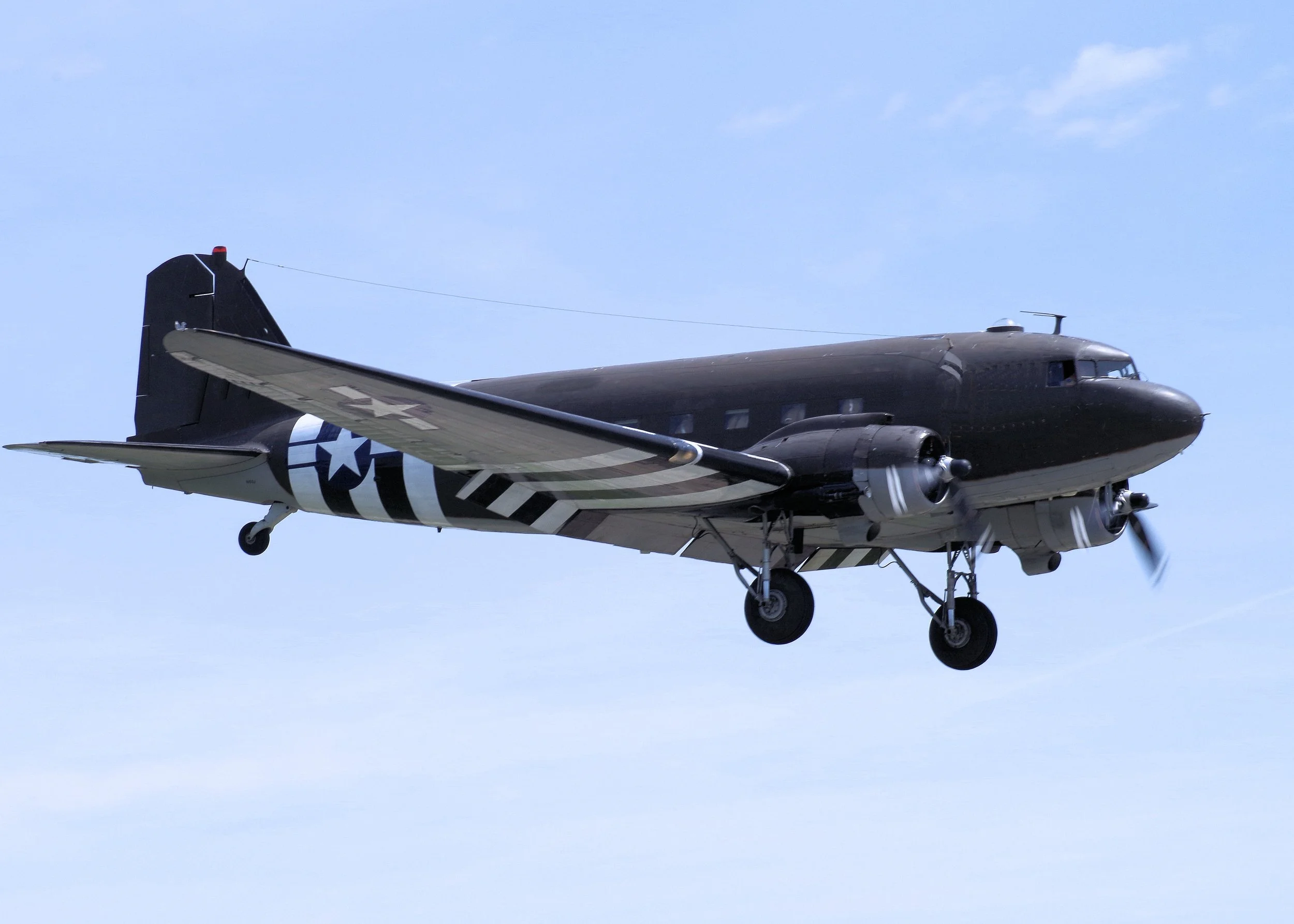
An Army Air Corp C-47
I wrote this at the beginning of the Ukraine war with the idea to show our "better angels." Now, with ICE in the streets and the government bombing boats and killing people in the Caribbean, I thought it might be a good time to remind us all of who we are when we are at our best in difficult times.
It was 1948, after the end of World War II, (or for the Russians, the end of the Great Patriotic War).
Berlin had been leveled by massive bombing, artillery, and house-to-house fighting primarily by Russian troops. After Germany's surrender, it was a humanitarian disaster. Infant mortality reached almost 90% (MacDonogh, Giles (2009). After the Reich: The Brutal History of the Allied Occupation.)
There was starvation, homelessness, and as you can imagine, not a lot of sympathy.(20 million Russians were killed during the war. Vengeance was in the air )
Defeated Germany was divided into occupation zones. Berlin was also divided into West and East (even though it was deep inside Russian-controlled East Germany).
After 1946, there was growing anxiety that the USSR, seeking revenge, a buffer against the West, and Communist hegemony, wanted control of Eastern Europe. This rising tension ultimately led to the Soviets' blockade of Berlin on June 24th, 1948.
Here is where our story begins.
Berlin was cut off from basic supplies, including food, medicine, and coal. In response, the Western Allies began the Berlin Airlift, one of the greatest logistical efforts of the 20th century. Until September 30th, 1949, American and British pilots flew over 250,000 missions into Berlin. At the height of the effort, planes were landing every 45 seconds. The American operation was called "Operation Vittles."
But within the operation, another drama was unfolding. An American pilot, Gail Halvorsen (he passed away in February of 2022), noted that German children were standing and watching planes land at Tempelhof Airport in Western Berlin. One day, while his plane was being refueled, he spoke to them and noted that they were thin and ragged, with nothing.
Lt. Halvorsen told the children that on his next flight, he would drop candy to them. And, because he was afraid that the candy would be heavy and dangerous falling out of a C-54, he made tiny parachutes out of handkerchiefs. He waggled the wings of his plane as it made its approach to the airport to let the kids know it was him. This went on for three weeks, and then the idea took off in his entire squadron. It was written up in the news in the United States, and all of a sudden, children and candy makers from all over the US were donating candy and handkerchiefs. The American pilots were known in Germany as the "Candy Bombers." 23 tons of candy were dropped guided to the ground by 250,000 tiny parachutes.
Two things strike me about this story. First, our ability to turn on a dime after a devastating war and come to the aid of our former enemy. There was geopolitics involved, for sure, but the fact remains that we and the allies saved a city from starving or freezing to death.
And as for the pilots and crews, after four years of seeing the horrors of war, it would have been easy to ignore just another group of suffering kids among the millions that were displaced in Europe in those years.
Yet Halvorsen saw suffering and decided to help. Then, following his lead, other crews jumped in, and the country followed.
I think about this story all the time. In my heart of hearts, I believe that is who we are, or at least what we can aspire to be again.
We live in difficult times. We have leadership that believes cruelty is strength, that empathy shows weakness. They idealise billionaires. They profess to be Christian, yet they seem deaf to Christ's words. (Give me a kind, compassionate atheist over a righteous evangelical any day)
And yet, there are "Gail Halvorsen's" among us everywhere you look. There are individuals, in every town and city, right-leaning and left-leaning, who embody the words of the nineteenth-century novelist Mary Ann Evans, "What do we live for, if it is not to make life less difficult for each other?"
It is a quirk of human nature that sometimes it takes a crisis, like 9/11 or the Pandemic, to wake us up and help us realize that "making life less difficult for each other" is the highest aspiration.
That impulse, to see suffering, to want to help, to want to make a difference, is inside all of us, there to be acted upon.
And don't be deluded by the performative, puffy-chest, pull-up-and-push-up-obsessed few who equate physical strength with courage. Courage abides in those who are kind to the less fortunate, who, as former Pope Francis wrote, see the homeless and want to help rather than see them as a menace, addicts,or as dissemblers.
As an example, a Fire Chief I interviewed a few years ago (and fire departments being the former bastions of hyper-masculinity) told me that it wasn't the engines or the running into burning buildings that impressed people. Rather, it was the kindness of the firefighters and EMTs, their desire to help the suffering, and to be there to comfort and give care.
Now we are in the season of rebirth and renewal. There are logistics to handle, parties to go to, shopping, and celebrating to be done. On one hand, it can all be a great distraction from the difficulties we face and the suffering that exists. Or, on the other hand, we can see our world, our block, city, community, neighborhood, as Gail Halvorsen might have seen them: a place to make life a little less difficult for others. We may not get to throw candy from airplanes, but we can be patient with others, look the homeless in the eye and wish them a better new year, and reflect on how we can use our courage and kindness in the new year.
Be brave. Be kind. Fight Fires.