Is Your Best Friend Empathic?
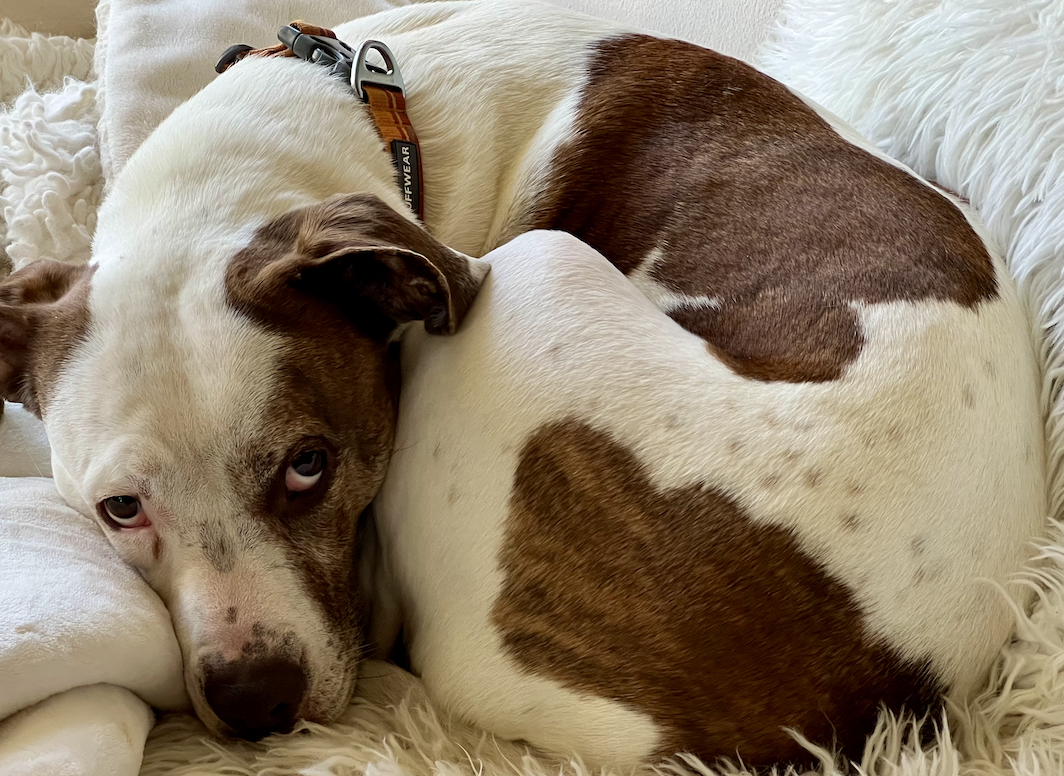
Baron at rest
Let's start with a story. My brother, Joey, who is 63, is an avid mountain biker. Most mornings you can find him on his bike in the Galisteo basin with his best pal, Baron, a five-year-old American Pit Bull.
Baron is a rescue Joey and his partner, Linda, adopted when he was a bit over a year old. He was just days away from being euthanized.
Baron is extremely attached to Joey. On walks, they play, lots of "rough and tumble," and on bike rides they often race each other. He's an energetic, fun-loving dog.
And then there was the crash.
A few weeks ago (three weeks and four days ago to be precise) Joey went on a ride by himself. That day he crashed, went over his handlebars, and ended up with nine broken ribs. I'm going to leave it to your imagination how painful and immobilizing it is to fracture multiple ribs.
Serendipitously, Skyline Search and Rescue was conducting a training at the basin that day. They helped Joey walk out, and one of the rescue techs drove him home to Santa Fe.
The heart of the story to come is how Baron reacted to Joey being hurt and basically immobile. But before we get there, I want to examine an embedded bias in our Western culture.
The primatologist Frans de Waal coined the term "anthropodenial" and defined it as "a blindness to the humanlike characteristics of other animals."
There are lots of reasons for this "blindness." Religious, historical, scientific, and practical assumptions conspire to reinforce our ego-centric position that humans are different, superior, and thus hold "dominion" over all other living creatures on the planet.
But for our story about Baron, let's step outside our "Anthropodenialism" and assume that all animals are sentient, feel pain, can suffer, and have a range of emotions we call "human."
At least just for this story.
Usually when Joey arrives home, Baron is excited to see him and jumps on him. This time was different. It took my brother five or so minutes to get out of his truck, then slowly, hunched over, begin to walk toward the house.
Normally I would write, "it was as if Baron sensed something was wrong," because I don't want to anthropomorphize (my college Psychology professor would bring out his red pen), but I'm going to jump right in and write: Baron sensed something was wrong. He slowly walked up to Joey,, and then, side by side, they carefully walked into the house.
In the house, they both crept to the couch. Of course, Baron, being a lively dog, usually jumps up on the couch. This time, as Joey carefully sat down, Baron imitated him and slowly, paw by paw, climbed onto the couch and nestled next to his best friend.
As you can imagine, the next few days included an ER visit, painkillers, and then living either on the couch or in bed. Baron stayed close. Joey and Linda clearly saw that Baron had taken on a new role: caretaker.
Six days out, Joey took Baron for their first walk since the crash. Normally, on leash, Baron pulls a bit and wants to investigate every rose bush and tree. This time, he walked alongside, leash slack, and didn't get distracted by other dogs or people. He continually looked up at Joey, making sure he was alright. Joey mentioned that he took extreme comfort in being with Baron.
Next, gleefully being anthropomorphic, Baron watched how Linda was the human caretaker. When Joey asked for help, Baron followed Linda. When Linda would call out to Joey, asking if he needed anything, Baron's ears would perk up.
Everything is slowly getting back to normal at the Joey/Linda/Baron household. I'm sure that both Baron and Joey dream about getting back to the basin and biking.
There are hundreds of stories like this, of these amazing animals who co-evolved with us, who depend on us for their survival. It doesn't take a leap of imagination to understand that they are sensitive to our emotions, that they care about and yes, love us.
Sometimes the most important thing we can do is to shine a light on the assumptions we carry, to see the living world as it is rather than as we've been taught. Sometimes all it takes is a dog to show us that empathy and sentience are all around us.